Actor portrayals.

Start your patients on the only non‑opioid, intrathecal option

Efficacy and dosing

INDICATION

PRIALT® (ziconotide) solution, intrathecal infusion is indicated for the management of severe chronic pain in adult patients for whom intrathecal (IT) therapy is warranted, and who are intolerant of or refractory to other treatment, such as systemic analgesics, adjunctive therapies, or IT morphine.

Clinical studies and safety

The efficacy of intrathecal PRIALT in the management of severe chronic pain was studied in three double-blind, placebo-controlled, multicenter studies in a total of 457 patients (268 PRIALT, 189 placebo). The first two studies utilized a fast titration schedule that resulted in less tolerability and substantially more frequent adverse events. Therefore, the third study utilized a slow titration schedule as follows1:

  • Randomized, double-blind, placebo-controlled study of PRIALT using the 21‑day slow titration schedule
  • Conducted in adult patients with severe chronic pain not adequately controlled with intrathecal analgesics, including morphine, bupivacaine, and/or clonidine; or who were intolerant to analgesics and/or systemic analgesics
  • Dosing with PRIALT was started at 2.4 mcg/day (0.1 mcg/hr)
  • Dosing was increased by 2.4 mcg/day (0.1 mcg/hr) two to three times/week (minimum titration interval 24 hours) to a maximum dose of 19.2 mcg/day (0.8 mcg/hr) as needed for management of pain
  • Final mean dose at the end of the trial at 21 days was 6.9 mcg/day (0.29 mcg/hr)

Slow titration, low-dose study results

The mean baseline pain scores in both the PRIALT and placebo groups were 81 mm on the VASPI (0-100 mm scale). After 3 weeks of treatment, the mean percent change in VASPI score from baseline improved by a mean of 12% in the PRIALT group vs 5% in the placebo group (intent-to-treat analysis; 95% [0.04%, 13%]).1,2

For adverse reactions in the slow titration, placebo-controlled trial, by percent, that occurred in ≥5% of patients and more commonly with PRIALT than with placebo, see Table 1 in Section 6.1 of the Prescribing Information.

The most frequently reported adverse reactions (≥25%) in clinical trials were dizziness, nausea, confusional state, and nystagmus.1

*As per mean percent change in Visual Analog Score of Pain Intensity (VASPI) score from baseline to Day 21 for both groups.1,2

PRIZM registry3

The Patient Registry of Intrathecal Ziconotide Management (PRIZM) was a real-world, prospective, multicenter, observational 18-month registry of 93 ziconotide patients with severe chronic pain.

  • Objectives: Evaluate the short- and long-term safety and effectiveness of IT ziconotide based on patient-reported outcomes
  • Primary efficacy outcome: Change in numeric pain rating scale (NPRS) score from baseline to Week 12 after enrollment
  • NPRS scores were assessed at every clinic visit, including at 6, 9, 12, 15, and 18 months

Observational analyses are NOT intended for direct comparison with clinical trials and may introduce bias. Real-world evidence can complement data from randomized controlled trials. The data presented below is observational and come from ad hoc, non-prespecified analyses. No conclusions of statistical or clinical significance can be drawn.


The results of patients who were given PRIALT as monotherapy are presented below:

  • 93 patients enrolled in the study, 74 patients completed 12 weeks (primary endpoint), and 60, 46, 37, 30, and 28 patients remained in the registry at 6, 9, 12, 15, and 18 months
  • 86% of patients were on ziconotide monotherapy at Week 12, 74% at Month 6, 55% at Month 12, and 57% at Month 18
  • Mean reduction in pain intensity level (NPRS score) over baseline was greater in the monotherapy group and led to a greater percentage of patients with a clinically meaningful response (30% reduction in NPRS score) at all time points
  • Week 12: 26%; Month 6: 41%; Month 9: 44%; Month 12: 50%; Month 15: 60%; Month 18: 43%

Almost all patients experienced adverse events, the most common of which were nausea (25.8%), confusional state (22.6%), and dizziness (20.4%). The treatment-emergent adverse event profile was similar to what was observed in the clinical trial program.1

NPRS=numeric pain rating scale.

When to prescribe PRIALT – the only FDA-approved, non-⁠opioid, intrathecal treatment for severe chronic pain

According to the 2016 Polyanalgesic Consensus Conference (PACC) guidelines, intrathecal therapy occupies the same line of management as neurostimulation, with important caveats regarding your patient's condition4:

  • Before in patients with active cancer-related pain that is mechanical and likely to spread (level III, grade C)
  • Within the same line in patients with non-⁠cancer pain (level III, grade C)
  • After for non-cancer pain if the pain is isolated and unlikely to spread (level III, grade I)

Recommendation made using United States Preventive Services Task Force (USPSTF) criteria. Evidence level III: Clinical experience-based opinions, descriptive studies, clinical observations, or reports of expert committees; Recommendation grade C: Neither recommendable nor inadvisable (at least moderate evidence that the measure is effective, but benefits are similar to harms and a general recommendation cannot be justified); Recommendation grade I: Insufficient, low quality, or contradictory evidence; the balance between benefit and harms cannot be determined.4
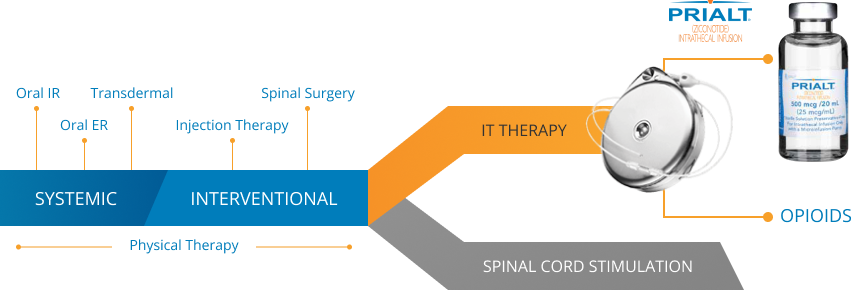
IT Therapy machine and vial of PRIALT IT Therapy machine and vial of PRIALT

ER=extended release; IR=immediate release.

First-line recommendation4

Evidence supports PRIALT efficacy in localized and diffuse non-cancer pain.4

Ziconotide, the analgesic agent of PRIALT, was identified as one of two preferred first-line IT options and included in the highest level of recommendation (level I, grade A) for those with non-cancer pain.4

Recommendation made using USPSTF criteria. Evidence level I: At least one controlled and randomized clinical trial, properly designed; Recommendation grade A: Extremely recommendable (good evidence that the measure is effective and benefits outweigh the harms).4

Steps for starting your patients on PRIALT

Establish patient expectations of intrathecal therapy:

  • Explain that PRIALT is FDA-approved and PACC guideline-recommended for adults with severe chronic pain1,4
  • Discuss the goals of treatment and that it may take time to respond1
  • Educate patients on potential adverse reactions and monitor their response to treatment1
  • Recommend psychological evaluation of patients to monitor for issues4
  • Continually monitor patients' progress and assess their response to treatment, including improvements to pain severity1

Start slow

According to the 2024 PACC Guidelines, the recommended starting dose for continuous IT delivery of PRIALT is 0.5-1.0 mcg/day—within the limit of no more than 2.4 mcg/day stated in the Full Prescribing Information.1,5

Consensus Point 23 – When titrating IT ziconotide dosing, an increase of ≤0.5 mcg/day with weekly reassessment is warranted (level I, grade B, certainty moderate).

§Recommendation made using USPSTF criteria. Evidence level I: At least one controlled and randomized clinical trial, properly designed4; Recommendation grade B: The PACC recommends the service or concept. There is high certainty that the net benefit is moderate, or there is moderate certainty that the net benefit is moderate to substantial. A moderate level of certainty means the available evidence is sufficient to determine the effects of the preventive service on health outcomes, but confidence in the estimate is constrained by various factors.5

Titrate to effect

Dosing example based on 2024 PACC Guidelines:

Assess each patient's response to therapy regularly to determine if a dose increase or decrease is required. Not all patients will require the same dose.

Monitor adverse events to manage outcomes

2024 PACC Guidelines also recommend:

Consensus Point 24 – When side effects occur, it is recommended to reduce the IT infusion dose of ziconotide to the last tolerated level that relieved pain without side effects. In the setting of severe side effects, it also is recommended that ziconotide can be discontinued without the risk of withdrawal (level II, grade B, certainty moderate).

Recommendation made using USPSTF criteria. Evidence level II: Expert opinion based on risk-benefit or on case reports; Recommendation grade B: The PACC recommends the service or concept. There is high certainty that the net benefit is moderate, or there is moderate certainty that the net benefit is moderate to substantial. A moderate level of certainty means the available evidence is sufficient to determine the effects of the preventive service on health outcomes, but confidence in the estimate is constrained by various factors.5

References: 1. PRIALT® (ziconotide). Prescribing Information. TerSera Therapeutics LLC. 2. Rauck RL, Wallace MS, Leong MS, et al. A randomized, double-blind, placebo-controlled study of intrathecal ziconotide in adults with severe chronic pain. J Pain Symptom Manage. 2006;31(5):393-406. 3. ⁠McDowell GC, Saulino MF, Wallace M, et al. Effectiveness and safety of intrathecal ziconotide: final results of the Patient Registry of Intrathecal Ziconotide Management (PRIZM). Pain Med. 2020;21(11):29​2​5‑2​9​3​8. 4. Deer TR, Pope JE, Hayek SM, et al. The Polyanalgesic Consensus Conference (PACC): recommendations on intrathecal drug infusion systems best practices and guidelines. Neuromodulation. 2017;20(2):96-132. 5. Deer TR, Hayek SM, Grider JS, et al. The Polyanalgesic Consensus Conference (PACC)®: intrathecal drug delivery guidance on safety and therapy optimization when treating chronic noncancer pain. Neuromodulation. 2024;27(7):1107-1139.

SUPPORT FOR YOU AND YOUR PATIENTS

Learn about PRIALT coverage support and download resources

RESOURCES for your patients

Explore resources for your patients

connect with a rep

Get dedicated assistance from your local representative

Attention

If you click “Continue” below, you will leave the current site. TerSera is not responsible for the privacy policy of any third-party websites. We encourage you to read the privacy policy of every website you visit.

Continue
Cancel

Healthcare Professionals

The information contained in this section of the site is intended for US Healthcare Professionals only. Click Continue if you are a healthcare professional.

Continue
Cancel

Healthcare Professionals

The information contained in this section of the site is intended for US Healthcare Professionals only. Click Continue if you are a US Healthcare Professional.

Continue
Cancel

Important Safety Information AND INDICATION

WARNING: NEUROPSYCHIATRIC ADVERSE REACTIONS

PRIALT is contraindicated in patients with a preexisting history of psychosis. Severe psychiatric symptoms and neurological impairment may occur during treatment with PRIALT. Monitor all patients frequently for evidence of cognitive impairment, hallucinations, or changes in mood or consciousness. Discontinue PRIALT therapy in the event of serious neurological or psychiatric signs or symptoms.

Contraindications

PRIALT is contraindicated in patients with:

  • A known hypersensitivity to ziconotide or any of its formulation components.
  • Any other concomitant treatment or medical condition that would render intrathecal administration hazardous, such as the presence of infection at the microinfusion injection site, uncontrolled bleeding diathesis, and spinal canal obstruction that impairs circulation of cerebrospinal fluid (CSF).
  • A pre-existing history of psychosis.

Warnings and Precautions

Cognitive and Neuropsychiatric Adverse Reactions

Severe psychiatric symptoms and neurological impairment may occur during treatment. Monitor all patients frequently for evidence of cognitive impairment, hallucinations, or changes in mood or consciousness. PRIALT may cause or worsen depression, with the risk of suicide in susceptible patients.

In clinical trials, 12% of patients reported hallucinations; other acute psychiatric events included paranoid reactions (3%), hostility (2%), delirium (2%), psychosis (1%), and manic reactions (0.4%).

Patients with pretreatment psychiatric disorders may be at an increased risk. Management of psychiatric complications may need to include discontinuation of PRIALT, treatment with psychotherapeutic agents and/or short-term hospitalization.

In clinical trials, cognitive adverse reactions included confusion (33%), memory impairment (22%), speech disorder (14%), aphasia (12%), thinking abnormal (8%), and amnesia (1%). Cognitive impairment may appear gradually after several weeks of treatment. Reduce the dose of PRIALT or discontinue the use of PRIALT if signs or symptoms of cognitive impairment develop, but other contributing causes must also be considered. The cognitive effects of PRIALT are generally reversible within 2 weeks after drug discontinuation. The elderly (≥65 years) are at higher risk for confusion. Concomitant use of central nervous system (CNS) depressants with PRIALT may have additive effects.

Meningitis and Other Infections

Meningitis can occur due to inadvertent contamination of the microinfusion device and other means. In clinical trials, the rate of meningitis was 3% (40 cases) in the PRIALT group using either internal or external microinfusion devices and 1% (1 case) with placebo. In patients with external microinfusion devices and catheters, meningitis occurred in 38 out of 41 patients (93%), 37 of whom received PRIALT and one who received placebo. Patients, caregivers, and healthcare providers must be particularly vigilant for the signs and symptoms of meningitis including, but not limited to, fever, headache, stiff neck, altered mental status (e.g., lethargy, confusion, disorientation), nausea or vomiting, and occasionally seizures.

Strict aseptic procedures must be used during the preparation of the PRIALT solution and refilling of the microinfusion device.

Reduced Level of Consciousness

In clinical trials, 2% of PRIALT-treated patients became unresponsive or stuporous. If reduced levels of consciousness occur, discontinue PRIALT until the event resolves, and other etiologies (e.g., meningitis) must be considered.

Elevation of Serum Creatine Kinase

In clinical trials, serum creatine kinase (CK) levels above the upper limit of normal (ULN) were reported in 40% of patients, with 11% of patients having CK levels >3 times ULN. Incidences were higher during the first 2 months of treatment. Serum CK should be monitored periodically. In the setting of new neuromuscular symptoms, evaluate patients, obtain CK measurements, and if symptoms continue and CK levels remain elevated or continue to rise, reduce the dose or discontinue the use of PRIALT.

Withdrawal From Opiates

PRIALT is not an opiate and cannot prevent or relieve the symptoms associated with the withdrawal of opiates. To avoid withdrawal syndrome when opiate withdrawal is necessary, do not abruptly reduce or withdraw opioid medications.

Driving and Operating Machinery

Use of PRIALT has been associated with cognitive impairment and decreased alertness/unresponsiveness. Caution patients against engaging in hazardous activities that require complete mental alertness or motor coordination.

Most Common Adverse Reactions

The most frequently reported adverse reactions (≥25%) in clinical trials (n=1254 PRIALT-treated patients) were dizziness, nausea, confusional state, and nystagmus. Slower titration of PRIALT may result in fewer serious adverse reactions and discontinuations for adverse reactions.

To report SUSPECTED ADVERSE REACTIONS, contact the FDA at 1‑800‑FDA‑1088 or www.FDA.gov/medwatch. You may also contact TerSera Therapeutics at 1‑844‑334‑4035 or medicalinformation@tersera.com.

Indication

PRIALT® (ziconotide) solution, intrathecal infusion is indicated for the management of severe chronic pain in adult patients for whom intrathecal (IT) therapy is warranted, and who are intolerant of or refractory to other treatment, such as systemic analgesics, adjunctive therapies, or IT morphine.

Please see accompanying Full Prescribing Information, including Boxed Warning.

Important Safety Information and Indication

WARNING: NEUROPSYCHIATRIC ADVERSE REACTIONS

PRIALT is contraindicated in patients with a preexisting history of psychosis. Severe psychiatric symptoms and neurological impairment may occur during treatment with PRIALT. Monitor all patients frequently for evidence of cognitive impairment, hallucinations, or changes in mood or consciousness. Discontinue PRIALT therapy in the event of serious neurological or psychiatric signs or symptoms.

Contraindications

PRIALT is contraindicated in patients with:

  • A known hypersensitivity to ziconotide or any of its formulation components.
  • Any other concomitant treatment or medical condition that would render intrathecal administration hazardous, such as the presence of infection at the microinfusion injection site, uncontrolled bleeding diathesis, and spinal canal obstruction that impairs circulation of cerebrospinal fluid (CSF).
  • A pre-existing history of psychosis.

Warnings and Precautions

Cognitive and Neuropsychiatric Adverse Reactions

Severe psychiatric symptoms and neurological impairment may occur during treatment. Monitor all patients frequently for evidence of cognitive impairment, hallucinations, or changes in mood or consciousness. PRIALT may cause or worsen depression, with the risk of suicide in susceptible patients.

In clinical trials, 12% of patients reported hallucinations; other acute psychiatric events included paranoid reactions (3%), hostility (2%), delirium (2%), psychosis (1%), and manic reactions (0.4%).

Patients with pretreatment psychiatric disorders may be at an increased risk. Management of psychiatric complications may need to include discontinuation of PRIALT, treatment with psychotherapeutic agents and/or short-term hospitalization.

In clinical trials, cognitive adverse reactions included confusion (33%), memory impairment (22%), speech disorder (14%), aphasia (12%), thinking abnormal (8%), and amnesia (1%). Cognitive impairment may appear gradually after several weeks of treatment. Reduce the dose of PRIALT or discontinue the use of PRIALT if signs or symptoms of cognitive impairment develop, but other contributing causes must also be considered. The cognitive effects of PRIALT are generally reversible within 2 weeks after drug discontinuation. The elderly (≥65 years) are at higher risk for confusion. Concomitant use of central nervous system (CNS) depressants with PRIALT may have additive effects.

Meningitis and Other Infections

Meningitis can occur due to inadvertent contamination of the microinfusion device and other means. In clinical trials, the rate of meningitis was 3% (40 cases) in the PRIALT group using either internal or external microinfusion devices and 1% (1 case) with placebo. In patients with external microinfusion devices and catheters, meningitis occurred in 38 out of 41 patients (93%), 37 of whom received PRIALT and one who received placebo. Patients, caregivers, and healthcare providers must be particularly vigilant for the signs and symptoms of meningitis including, but not limited to, fever, headache, stiff neck, altered mental status (e.g., lethargy, confusion, disorientation), nausea or vomiting, and occasionally seizures.

Strict aseptic procedures must be used during the preparation of the PRIALT solution and refilling of the microinfusion device.

Reduced Level of Consciousness

In clinical trials, 2% of PRIALT-treated patients became unresponsive or stuporous. If reduced levels of consciousness occur, discontinue PRIALT until the event resolves, and other etiologies (e.g., meningitis) must be considered.

Elevation of Serum Creatine Kinase

In clinical trials, serum creatine kinase (CK) levels above the upper limit of normal (ULN) were reported in 40% of patients, with 11% of patients having CK levels >3 times ULN. Incidences were higher during the first 2 months of treatment. Serum CK should be monitored periodically. In the setting of new neuromuscular symptoms, evaluate patients, obtain CK measurements, and if symptoms continue and CK levels remain elevated or continue to rise, reduce the dose or discontinue the use of PRIALT.

Withdrawal From Opiates

PRIALT is not an opiate and cannot prevent or relieve the symptoms associated with the withdrawal of opiates. To avoid withdrawal syndrome when opiate withdrawal is necessary, do not abruptly reduce or withdraw opioid medications.

Driving and Operating Machinery

Use of PRIALT has been associated with cognitive impairment and decreased alertness/unresponsiveness. Caution patients against engaging in hazardous activities that require complete mental alertness or motor coordination.

Most Common Adverse Reactions

The most frequently reported adverse reactions (≥25%) in clinical trials (n=1254 PRIALT-treated patients) were dizziness, nausea, confusional state, and nystagmus. Slower titration of PRIALT may result in fewer serious adverse reactions and discontinuations for adverse reactions.

To report SUSPECTED ADVERSE REACTIONS, contact the FDA at 1‑800‑FDA‑1088 or www.FDA.gov/medwatch. You may also contact TerSera Therapeutics at 1‑844‑334‑4035 or medicalinformation@tersera.com.

Indication

PRIALT® (ziconotide) solution, intrathecal infusion is indicated for the management of severe chronic pain in adult patients for whom intrathecal (IT) therapy is warranted, and who are intolerant of or refractory to other treatment, such as systemic analgesics, adjunctive therapies, or IT morphine.

Please see accompanying Full Prescribing Information, including Boxed Warning.